
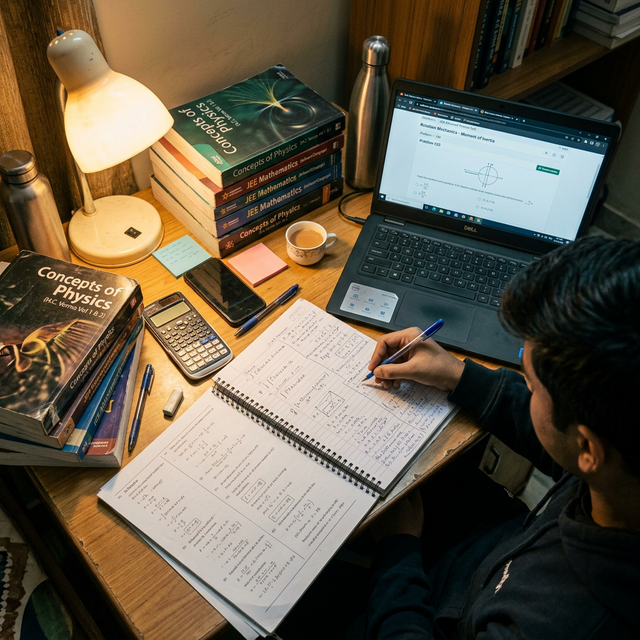
JEE Main is the gateway examination for admission to NITs, IIITs, and over 2,500 engineering colleges across India. With approximately 12 lakh candidates competing for limited seats, having a structured preparation strategy is not optional — it's essential. This guide breaks down the exam pattern, subject-wise strategy, best resources, and provides a detailed 6-month roadmap.
Understanding JEE Main 2026
Exam Pattern
Parameter
Details
Mode
Computer Based Test (CBT)
Duration
3 Hours
Sections
Physics, Chemistry, Mathematics
Questions per section
30 (20 MCQ + 10 Numerical, attempt 25)
Total marks
300
Marking
+4 correct, -1 wrong (MCQ), No negative (Numerical)
Sessions
January & April
Language
13 languages including Hindi and English
What's New in 2026
NTA has introduced minor pattern adjustments. The numerical value questions now have a defined range, reducing guesswork. Additionally, the normalization process has been refined to better account for difficulty variations across sessions.
Subject-wise Deep Dive
Physics — The Problem-Solving Subject (100 marks)
Physics in JEE Main requires conceptual understanding combined with mathematical application. Here's the topic-wise weightage based on analysis of the last 5 years:
High Weightage Topics (60% of marks):
Mechanics: 25-30% — Focus on Newton's Laws, Work-Energy Theorem, Rotational Mechanics
Electrodynamics: 20-25% — Current Electricity, Electromagnetic Induction, AC circuits
Modern Physics: 10-12% — Photoelectric Effect, Atomic Structure, Nuclear Physics
Strategy:
Start with Mechanics as it forms the foundation. Solve HC Verma's Concepts of Physics cover to cover. For each chapter, first understand the theory, then solve all examples, then attempt exercises.
Chemistry — The Scoring Subject (100 marks)
Chemistry offers the best marks-to-effort ratio. NCERT mastery alone can fetch 60-70 marks.
Physical Chemistry (35-40%):
Thermodynamics, Electrochemistry, and Chemical Kinetics are annual fixtures
Practice numerical problems from N. Avasthi
Memorize key formulas but understand their derivations
Organic Chemistry (25-30%):
Master Named Reactions and Reaction Mechanisms
GOC (General Organic Chemistry) is the foundation — don't skip it
Use MS Chouhan for mechanism-based practice
Inorganic Chemistry (25-30%):
NCERT is the bible — read every table, every exception, every footnote
Create mnemonics for periodic properties, metallurgy, and p-block trends
Coordination compounds and Chemical Bonding are high-yield
Mathematics — The Differentiator (100 marks)
Mathematics has the highest weightage and the steepest difficulty curve. Top scorers typically score 80+ here.
Must-master topics:
Coordinate Geometry (15-18%): Straight Lines, Circles, Conics
Calculus (18-22%): Limits, Differentiation, Integration (definite + indefinite)
Algebra (15-18%): Sequences & Series, Complex Numbers, Matrices
Practice strategy:
Solve minimum 30 problems daily. Start with Cengage series for each topic, then graduate to previous year papers.
The 6-Month Study Plan
Months 1-2: Foundation Building
Complete NCERT for all three subjects
Solve all NCERT examples and exercises
Begin HC Verma (Physics) and Cengage (Maths)
Cover all Organic Named Reactions
Months 3-4: Problem Solving Phase
Attempt 2-3 chapter tests per week
Complete one reference book per subject
Start Previous Year Papers (2019-2025)
Identify and strengthen weak topics
Month 5: Mock Test Phase
Take 3 full mock tests per week
Analyse every mock — track time per question, accuracy per topic
Create an error log and revise common mistakes daily
Focus 70% of study time on weak areas
Month 6: Revision & Sharpening
Revise formula sheets daily (create during Month 4)
Solve 1 full previous year paper daily under timed conditions
No new topics — only revision and practice
Maintain sleep schedule — 7-8 hours is non-negotiable
Best Resources
Subject
Resource
Purpose
Physics
HC Verma
Conceptual foundation
Physics
DC Pandey
Advanced problems
Chemistry
NCERT + N. Avasthi
Core + Physical Chem
Chemistry
MS Chouhan
Organic mechanisms
Maths
Cengage Series
Comprehensive practice
Maths
RD Sharma Objective
Quick practice
All
NTA Official Mocks
Exam simulation
Common Mistakes to Avoid
Ignoring NCERT
— 30-35% of Chemistry comes directly from NCERT
Too many books
— Master 2-3 books rather than skimming 10
Skipping mock analysis
— Taking mocks without analysis is wasted effort
Neglecting numerical questions
— These 50 marks have no negative marking
Last-minute topic hopping
— Stick to your plan in the final month
After JEE Main: What Next?
A good JEE Main score opens doors to NITs and IIITs through JoSAA counselling. Top performers also qualify for JEE Advanced (IIT admission). Explore our complete list of colleges that accept JEE Main scores, including UPES, Thapar, and Bennett, to find the best fit for your rank range.
The journey to cracking JEE Main is a marathon, not a sprint. Start early, stay consistent, and trust the process.